


The pace of AI is accelerating. Your hosting strategy should too.
From GPT-4 to open-source challengers like Mixtral, Llama 3, and Claude 3, Large Language Models (LLMs) are evolving at breakneck speed. And while the world debates AGI timelines, companies face a very practical dilemma:
How do you build an infrastructure strategy today — when tomorrow’s models may be smarter, faster, and totally different?
In this post, we dive into what’s changing in AI hosting, what’s coming next, and how to prepare your stack for a future that’s moving faster than ever.
🚀 The AI Hosting Landscape Is Shifting Fast
Let’s be blunt: the infrastructure you used to fine-tune a small BERT model in 2022 likely won’t cut it for serving a RAG-based agent running on GPT-4-turbo, let alone future multimodal systems.
Key Trends to Watch:
- Model sizes are growing. GPT-4 reportedly exceeds 1.7 trillion parameters (though exact numbers are secret).
- Inference costs are under pressure. Even OpenAI’s Claude 3 rivals are competing on token efficiency and memory optimization.
- Edge and quantized models are rising. LLMs like Phi-3 or Mistral are proving you don’t always need a cluster of A100s to get real-world value.
- Multimodality is here. Hosting now means handling text, vision, and even audio streams — not just prompts and completions.
🔁 “The challenge isn’t just scaling up — it’s scaling smart.” — Andrej Karpathy, AI researcher and founding member of OpenAI
📉 The Cost Pitfall: Why Many LLM Projects Burn Out
GPU costs and cloud bills are derailing AI roadmaps. Running large models 24/7, especially for inference at scale, requires:
- High-performance GPUs (A100s, H100s) with reliable provisioning
- Fast I/O and memory bandwidth for token throughput
- Low-latency networking to avoid bottlenecks in distributed systems
- Robust orchestration (Kubernetes, Ray, or custom autoscaling)
Yet, startups and even mid-sized SaaS players often overspend early, locking into cloud contracts that don’t fit long-term needs.
🛠️ Smart Hosting Strategies for the Next 5 Years
Let’s look at what works now — and how to future-proof your infrastructure:
1. Short-Term: Be Agile and GPU-Efficient
- Run lightweight LLMs locally (e.g. Mistral 7B, LLaMA-3 8B).
- Use quantized models (4-bit, 8-bit) to reduce RAM/GPU demand.
- Leverage managed services like AWS Bedrock or OpenRouter.io for prototyping.
💡 Don’t buy a Ferrari to deliver pizza. Match the model to the mission.
2. Mid-Term: Embrace Hybrid Hosting
- Use a mix of cloud inference APIs and bare-metal servers.
- Deploy your core stack on scalable containers (Docker + Kubernetes).
- Consider AI-optimized VPS hosts for low-latency edge inference.
Pro Tip: Many LLM workloads don’t need 24/7 GPU uptime. Use serverless endpoints or spot instances where possible.
3. Long-Term: Plan for Modularity
- Avoid hardcoding dependencies to a single model or provider.
- Structure your stack for swappable backends (e.g., local LLaMA vs OpenAI API).
- Prepare for multi-agent systems, where orchestration becomes the bottleneck.
Also think beyond just model serving:
- Will you host vector DBs like Pinecone or Qdrant?
- Will you integrate custom embedding pipelines?
- Will your users upload images or voice prompts?
🔄 Balancing Innovation vs. Sustainability
The reality:
- AGI-level ambitions need more GPU.
- Open-source innovation pushes toward efficiency.
Both trends will coexist. The winning strategy? Build a flexible, modular infrastructure that allows you to scale both up and down, depending on the use case.
✅ Hosting Checklist for 2025–2030 LLM Teams
| 🔍 Feature | Why It Matters |
|---|---|
| GPU-ready VPS / Bare Metal | For when you scale beyond APIs |
| Hybrid Multi-cloud Support | Avoid lock-in, optimize cost |
| CDN & Edge Capabilities | For latency-critical agents |
| Container & Orchestration | For modularity and portability |
| Model Agnostic Backend | Swap GPT → Mistral → Claude |
| API Gateway & Rate Limiting | Essential for public LLM access |
| Sustainability Support | Carbon-aware hosting is becoming a differentiator |
🎯 Final Thought
LLMs will keep evolving. Some will shrink. Some will explode in size. Some will reason. Some will observe.
But your hosting needs to evolve with them — not react to them.
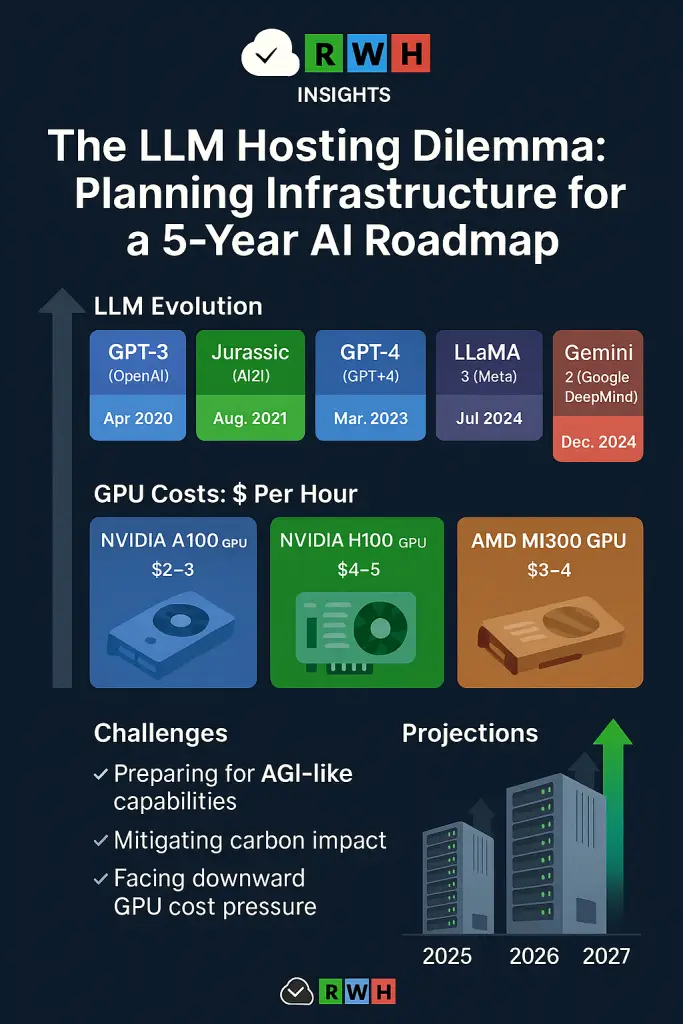
A 5-year roadmap doesn’t mean predicting the models of 2030. It means designing infrastructure that can flex, adapt, and grow smarter over time.
🧭 Need help planning your AI hosting strategy?
Let the experts at RightWebHost™ help you navigate this evolving landscape — with clarity, cost-efficiency, and confidence.
